

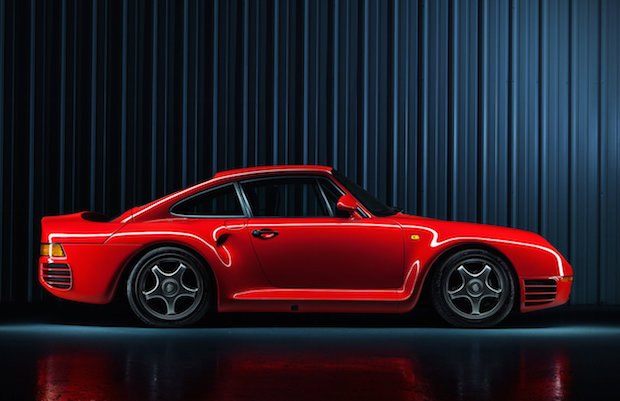
The Porsche 959 is one of the most revolutionary supercars of the 1980s, blending cutting-edge technology with breathtaking performance. Designed to push boundaries, it dominated the Paris-Dakar Rally and laid the foundation for modern supercars. Even today, the Porsche 959 remains an icon in Senegal, where its legacy continues to inspire car enthusiasts.
A Rally-Inspired All-Wheel Drive System
The Porsche 959 was initially designed for the high-performance world of Group B rally racing. Built with an advanced all-wheel-drive system, the car was engineered to tackle extreme terrains, making it ideal for events like the Paris-Dakar Rally. Although Group B was canceled before the car could fully compete, Porsche still brought it to Dakar, proving its ruggedness and reliability.
In the 1986 Paris-Dakar Rally, the Porsche 959 secured a first-place victory, showing its ability to handle the toughest conditions. The lessons learned from this race influenced the development of future all-wheel-drive Porsche models, including the 911 Turbo and Cayenne.
A Twin-Turbo Engine Built for Speed
Under the hood, the Porsche 959 packed a 2.8-liter twin-turbocharged flat-six engine. Despite its relatively small displacement, the car delivered an impressive 444 horsepower and 369 lb-ft of torque. This power allowed the supercar to sprint from 0-100 km/h in just 3.7 seconds and reach a top speed of nearly 320 km/h.
This level of performance made the Porsche 959 one of the fastest cars of its era, standing alongside icons like the Ferrari F40 and Lamborghini Countach. The use of twin-turbo technology was ahead of its time and set the stage for future Porsche models.

Advanced Aerodynamics and Lightweight Design
Visually, the Porsche 959 resembled a futuristic version of the classic 911, featuring an extended body with wide fenders, aerodynamic vents, and an integrated rear wing. Built using aluminum and carbon fiber, it was significantly lighter than other supercars, enhancing both speed and handling.
The lightweight construction and aerodynamics not only improved track performance but also made the car stable at high speeds, whether on the highways of Europe or the rugged landscapes of Senegal.

A Legacy That Lives On in Senegal
The Porsche 959 may be rare, but its influence can still be seen in modern Porsche models. Its pioneering all-wheel-drive system, twin-turbocharged engine, and aerodynamic design continue to shape the brand’s engineering philosophy.
For car lovers in Senegal, the story of the Porsche 959 is a testament to innovation and endurance. Whether in Dakar or beyond, this supercar remains a symbol of Porsche’s relentless pursuit of perfection.
Have you ever seen a Porsche 959 in Senegal? Share your thoughts in the comments! For more insights into Porsche’s legacy, visit Auto24 Senegal.